
Participants & Contact Info

Marianne Graves Petersen

Line Have Musaeus

Thomas Thomsen
Have questions about CoTinker or want to know more? Contact any of the team members listed above. We love hearing from teachers who want to try our activities or researchers looking to collaborate. Feel free to reach out with questions or to chat about what we’re doing with informatics education. Looking for CoTinker and learning activities support instead? Click below to get support.

The CoTinker Tech Stack
Computational Thinking Support
CoTinker is a web-based tool designed to support the facilitation of computational thinking learning activities. The design of CoTinker addresses challenges that arise in scaffolding computational thinking activities, collaboration between students, and technical integration between the different subactivities (coding, running a simulation, documenting work) of learning activities.
Multi-Device Learning Activities
CoTinker’s central concept is the learning activity: An interactive digital document or a piece of computational media describing and containing the steps and materials involved in the activity. A master learning activity is created by an instructor and students copy one per group with its own unique URL and share it between them. Each student in a group opens this URL on their respective computers to participate. Some CoTinker learning activities requires the user to use both a phone and a PC simultaneously. When opening the URL for a learning activity on a PC, a QR-code is shown. Scanning this code on a mobile will navigate the browser to the same URL and establish a connection between the mobile and the PC and the student will hereby join the learning activity. If the browser tab is closed on the mobile phone the connection is closed and the PC will return to the screen showing the QR code.
Collaborative Step-by-Step Navigation
A learning activity contains step-wise instructions accessed on a mobile phone and interactive elements such as editable code and a simulation viewed on a personal computer (PC) contained in slides. Students using the same learning activity will see the same steps at the same time and navigate between them together. Navigation is controlled from the phone or computer. If a student moves to the next step, all other students will be moved to the next step as well. A slide may contain static content (e.g., the front page of a learning activity) or interactive content such as the simulation view and/or editable code. Steps on the phone contain instructions and hyperlinks that, e.g., will highlight particular code in a slide on the PC and means for making short written comments.
Codestrates
Codestrates: The Engine Behind CoTinker
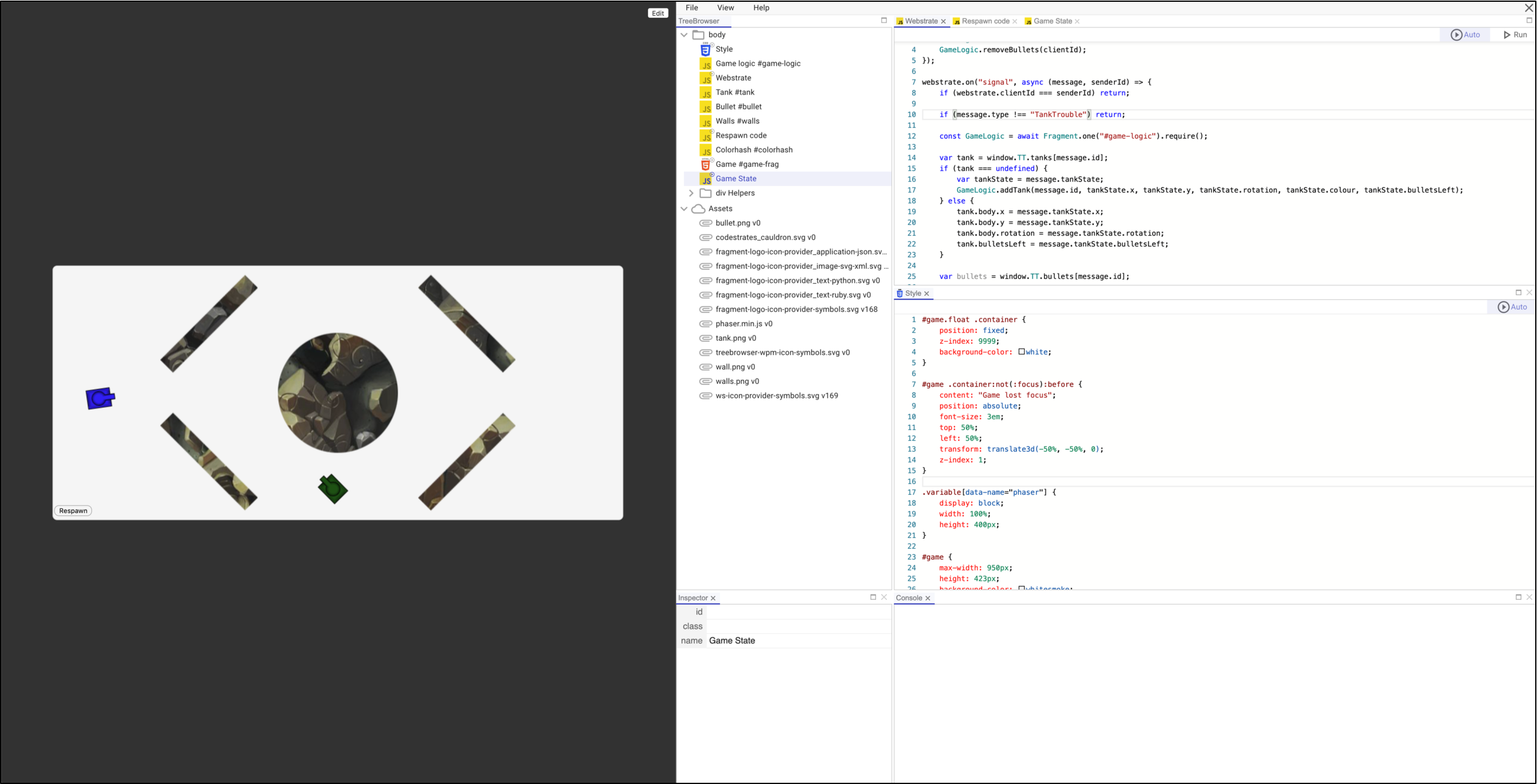
CoTinker is build using Codestrates. Codestrates is a development platform for the Webstrates platform developed by researchers at Department of Computer Science at Aarhus University. With Codestrates, you can create dynamic webpages (or webstrates as we call them) that can be edited directly from within the browser — and editing can also be done collaboratively. Codestrates consists of three components: The Webstrates Package Manager, the Execution engine, and the authoring environment Cauldron. Together, the three components create a development platform for Webstrates on top of Webstrates.
Webstrates: The Engine Behind Codestrates
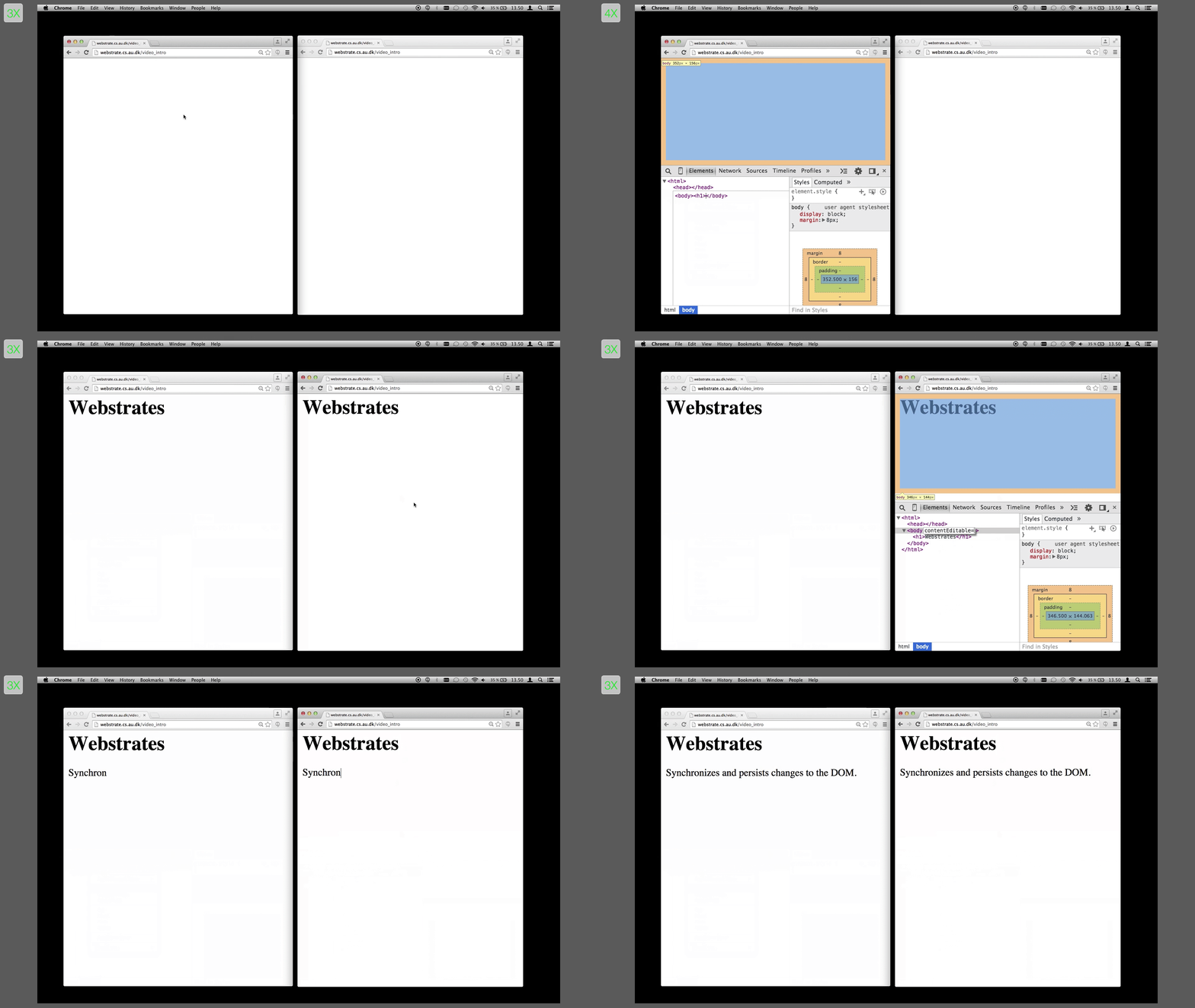
Webstrates is a platform to explore software as computational media developed by researchers at Department of Computer Science at Aarhus University. Webstrates is a webserver where the pages it serves are collaboratively editable. This means that modifications to the Document Object Model (DOM), for instance, using the developer tools of a web browser, are synchronized with the server and with all other clients currently visiting the same webpage. We call such a webpage a webstrate (short for web + substrate). By storing HTML, CSS, and JavaScript in the DOM this enables to create collaborative web applications.
Project participants
This project is carried out as a collaboration with CAVI, School of Communication and Culture, Aarhus University. CAVI is a research center at the School of Communication and Culture, department of Digital Design and Information Studies, in collaboration with department of Computer Science. CAVI was established in 2001 as an interdisciplinary Human-Computer Interaction research centre across the Department of Information Studies and the Department of Computer Science, Aarhus University.
CoTinker is part of Center for Computational Thinking and Design (CCTD), Aarhus University. CCTD was founded in 2018 to set the agenda for international research and to develop research-based education with an emphasis on digital technology (TechEd) to strengthen citizens’ digital competences and their democratic participation in a digitalized society.
Funding partners
This project is funded by Novo Nordisk Foundation and initially funded by It-vest - networking universities, Aarhus.


Papers
The CoTinker project has produced a number of papers written in collaboration with various partners, which can be seen below:
Line Have Musaeus, Marianne Graves Petersen, and Clemens Nylandsted Klokmose. 2024. Bringing Teachers and Researchers together through Participatory Design and Cooperative Prototyping in Computing Education. In Proceedings of the 55th ACM Technical Symposium on Computer Science. Link to paper
Nathalie Bressa, Susanne Bødker, Clemens Klokmose, Eva Eriksson. Common Objects for Programming Workshops in Non-Formal Learning Contexts. IFIP Conference on Human-Computer Interaction, Aug 2023, York, United Kingdom. pp.275-296, 10.1007/978-3-031-42280-5_16. hal-04377024. Link to paper
Line Have Musaeus, Marie-Louise Stisen Kjerstein Sørensen, Blanka Sára Palfi, Ole Sejer Iversen, Clemens Nylandsted Klokmose, and Marianne Graves Petersen. 2022. CoTinker: Designing a Cross-device Collaboration Tool to Support Computational Thinking in Remote Group Work in High School Biology. In Nordic Human-Computer Interaction Conference (NordiCHI '22), October 8–12, 2022, Aarhus, Denmark. ACM, New York, NY, USA, 12 pages. https://doi.org/10.1145/3546155.3546709. Link to paper
Musaeus, L. H., Petersen, M. G., Klokmose, C. N., & Iversen, O. S. (2022, March). CoTinker-A Toolkit for Supporting Computational Thinking and Collaboration in High School Education. In Proceedings of the 53rd ACM Technical Symposium on Computer Science Education V. 2 (pp. 1025-1025). Link to paper
Marcel Borowski, Janus Bager Kristensen, Rolf Bagge, and Clemens N. Klokmose. 2021. Codestrates v2: A Development Platform for Webstrates. Technical Report. Aarhus University. https://pure.au.dk/portal/en/publications/codestrates-v2-a-development-platform-for-webstrates. Link to paper
Clemens N. Klokmose, James R. Eagan, Siemen Baader, Wendy Mackay, and Michel Beaudouin-Lafon. 2015. Webstrates: Shareable Dynamic Media. In Proceedings of the 28th Annual ACM Symposium on User Interface Software & Technology (UIST '15). Association for Computing Machinery, New York, NY, USA, 280–290. https://doi.org/10.1145/2807442.2807446. Link to paper